Loading…
PLAN AUTOMATION · OBSERVABILITY · AGENT SECURITY · ON-PREM · OIL & GAS
AI Document Analyzer — Engineering Standards Review
From 18 days to 5–6: AI-assisted review for engineering standards, fully on-prem. The flagship build.
THE CHALLENGE
Engineering teams comparing project documents against international standards and internal procedures ran a 18-day manual review cycle. The real blocker wasn't bulk text — it was the parts of a document conventional OCR couldn't read: arrows from callout boxes into a specific cell of a dense parts table, highlighted ink on top of drawings, comments anchored to coordinates rather than text. Standard OCR loses the link between the comment and what it's pointing at.
THE APPROACH
A fully on-prem, open-source document understanding pipeline combined with a structured four-way decision workflow (Accept / Accept with Comment / Reject / Recommend). The system reads, compares, and surfaces what changed; humans decide and edit in Word; the system then verifies edits actually addressed required changes before submission. No auto-editing — the regulated workflow forbids it.
STACK / HOW IT WORKS
How it works.
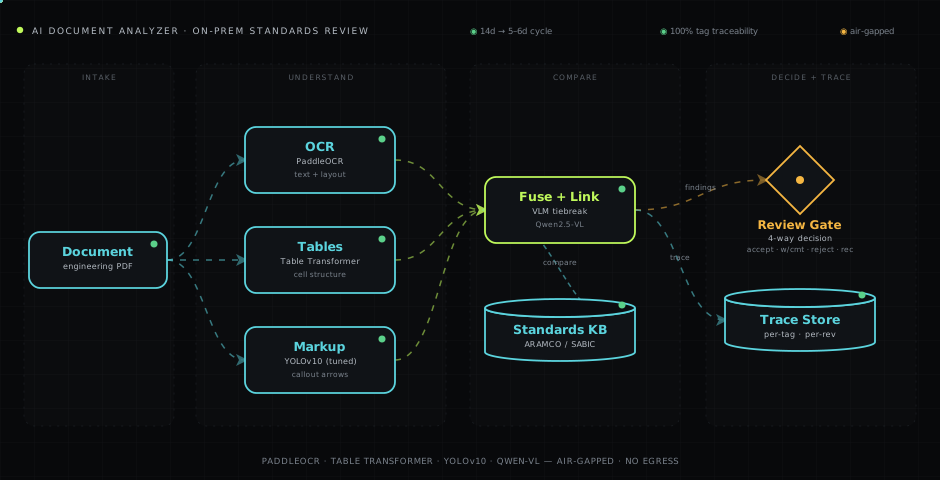
PaddleOCR 3.0
PP-OCRv5 + PP-StructureV3 for text and layout blocks.
Table Transformer (TATR)
Cell-level row/column grids on dense tables.
YOLOv10 (fine-tuned)
Detects arrowheads, callout boxes, highlights, ink.
M-LSD + DT-LSD
Recovers leader-line shafts; joins arrowheads to lines.
SAM-2
Refines translucent highlight and ink masks.
Qwen2.5-VL
On-prem VLM tiebreaker for ambiguous links.
FAISS + OpenSearch
Vector retrieval + full-text traceability.
OUTCOMES
What it delivered.
14 → 5–6
Days · review cycle (target)
≥85%
Diff-detection accuracy (target)
≥90%
Comment extraction (target)
100%
Revision traceability per tag
ARCHITECTURE
How it's built.
THE HARD PART
Engineering review comments live on top of dense tables and drawings — an arrow pointing from a callout box into a specific cell of a parts table is the comment. Generic OCR loses that link. Our pipeline reconstructs it: arrowheads are snapped to TATR's cell grid so a markup attached to a row is correctly linked to that row.
WHY IT MATTERS
Cuts a 18-day standards-review cycle to a 5–6 day target by giving humans a credible AI-assisted starting point — with policy, observability, and security built in, not bolted on. Every action is traceable per equipment tag across every revision.
WORK WITH US
Want something like this built?
Tell us what you're trying to ship. A real engineer replies — no pitch.